History
Congregation Rodeph Shalom dates its founding to 1795 with the coalescing of the first Ashkenazic congregation in the Western Hemisphere. Because the congregation chose to follow the German/Dutch order of prayer, in 1803 it was chartered by the Supreme Court of Pennsylvania as the “Hebrew German Society (Rodeph Shalom).” Records were kept in German until 1830, and was known as the congregation of “recent immigrants” until 1840.
From its founding, Rodeph Shalom was determined not to exclude members based on financial circumstances. The congregation differentiated itself from Congregation Mikveh Israel mainly by offering Philadelphia Jews of northern European origin membership at reduced rates and, in cases of hardship, no fee. Additionally, rabbis were permitted to extend aid of up to $5 to any sick or poor person. But there was a quid pro quo for this commitment: absence from Friday evening or Saturday morning services was punishable by fine, excused only by sickness or travel out of town.
Additionally, in 1829, a rule about intermarriage was established: “Members who married non-Jews would not be expelled as long as they raised their children as Jews.”
For over fifty years, services were conducted in numerous locations throughout “Olde City Philadelphia.” The Board meetings were held in a tavern. Not until 1847, when a former church was purchased and refurbished, did Rodeph Shalom have its own building: the Juliana Street Synagogue.
Rodeph Shalom was able to construct its first dedicated sanctuary in 1871 on its current site at Broad and Mount Vernon Streets. This striking edifice was designed by Frank Furness, considered the most exciting Philadelphia architect of his time. It was a showpiece of Moorish Byzantine-style architecture.
History – Simon & Simon Building
In 1925 when Rodeph Shalom outgrew its first building, the membership decided to raze the 60-year-old Frank Furness building and erect a new, larger synagogue on the same site. The Congregation’s needs had changed. Communal facilities, including the school, library and an auditorium were now important aspects of synagogue-life. The Furness building only housed the sanctuary, the school was located several blocks away. The Victorian architecture was no longer in style, so the Congregation decided to start over.
The Congregation’s Board debated moving to a new site on the growing area around the Art Museum or building at the current location. Ultimately the Board decided to stay on Broad Street, because of the proximity of the newly built Broad Street subway line. The City finished construction of the subway days before the open of the new building.
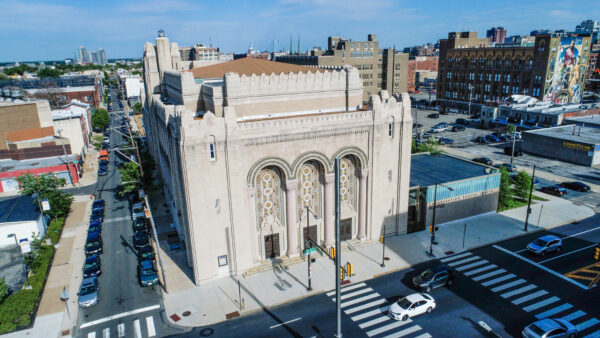
Inspired by the great Synagogue of Florence, Italy, RS is one of the only synagogues in the United States that retains the Byzantine-Moorish style. The building was designed by the firm of Simon and Simon; the stained glass, hand-stenciled walls and star burst dome light by the D’Ascenzo Studio.
The Ark in the Sanctuary is Italian marble and the Ark doors, made of Italian bronze, weigh 1,000 pounds each. In the Ark, are six Torah scrolls, the smallest of which was rescued during the Holocaust from Brno, a small town in the Czech Republic and given to Rodeph Shalom as a gift from Rabbi Wice upon his retirement in 1981.
The “new” synagogue was erected in 1927 – 28 at the cost of over $1,000,000. The building’s design reflects the increased emphasis on educational, social, and recreational facilities. These functions occupy more than 65% of the building, which was clearly divided into two deliberate but attached structures: the synagogue and the synagogue house. At the time of its completion the building was described as “suggesting strongly the oriental influences that have been so characteristic of the great Jewish tradition in temples of worship. The edifice is also a unique recognition of the thought that American Religious life must necessarily express itself in new forms tending towards a new and distinctly American Architecture in our secular life.”
